


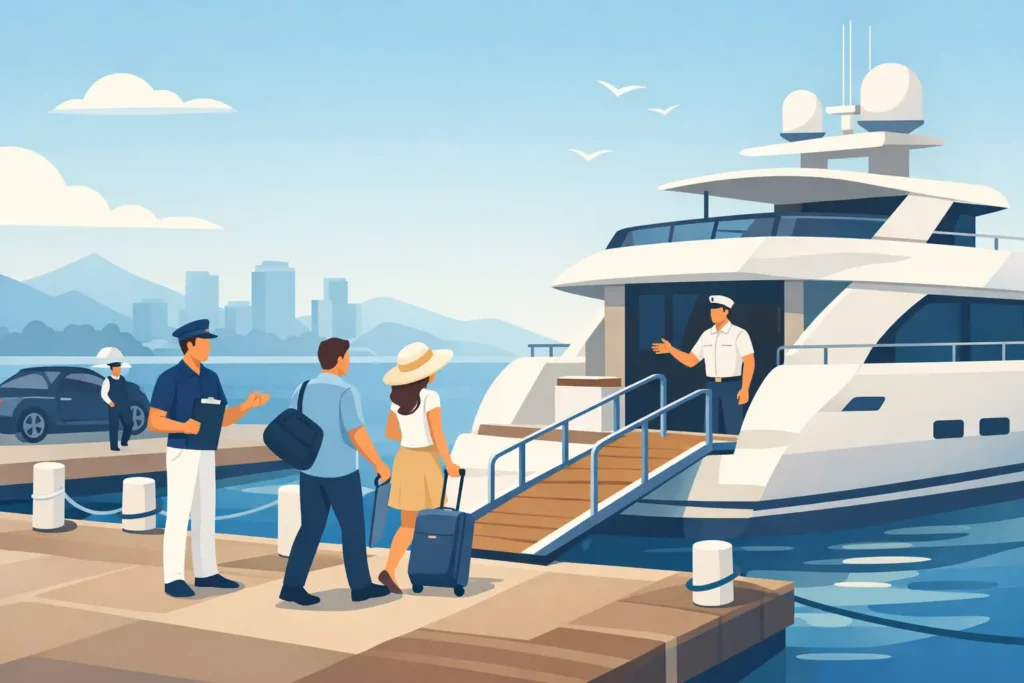
The first impression of a private yacht day is made before the engines start. Understanding how private yacht boarding works removes uncertainty from the experience and leaves room for what matters: arriving composed, stepping aboard comfortably, and seeing the coast from the water on your own terms.
For a premium private charter, boarding is not an impersonal queue at a public terminal. It is a coordinated handoff between land and sea, shaped around your group, the selected departure point, weather conditions, and the operational realities of the marina that day. The best boarding experience feels effortless precisely because every detail has been considered in advance.
Before the dock: confirmation and coordination
A private charter normally begins with a personal confirmation of the essential details: departure time, number of guests, departure marina, itinerary preferences, and any special requests. This is the moment to share information that will improve the day, from dietary needs and celebration plans to mobility considerations, children traveling with the group, or a preference for a particularly quiet itinerary.
The meeting point is usually arranged close to the yacht’s berth or at a practical marina access point. In destinations such as Sorrento, Capri, Positano, and Marina di Stabia, access can vary substantially according to the harbor layout, pedestrian traffic, local restrictions, and the berth assigned to the yacht. A precise meeting time matters. Arriving a few minutes early is ideal, while arriving very early can be less useful if marina access is controlled or the yacht is completing final preparations.
A professional crew or charter representative will provide clear arrival instructions rather than expecting guests to search the docks. Private marinas are working environments, with mooring lines, service vehicles, and uneven surfaces underfoot. Good guidance is part of a first-class service, not an afterthought.
What to bring, and what to leave behind
For a day charter, light luggage is generally the most elegant choice. A soft-sided beach bag, sunscreen, sunglasses, a hat, swimwear, and a light cover-up are usually enough. Soft bags are easier to stow and kinder to the yacht’s finishes than rigid cases.
If you are joining the yacht after checking out of a hotel or traveling onward after the cruise, tell the charter provider before the day of departure. Larger luggage can often be accommodated, but space aboard a refined 42-foot yacht is intentionally devoted to guest comfort rather than oversized baggage. Advance notice allows the crew to organize storage properly or advise on the most practical solution.
Footwear deserves a moment of consideration. Flat, secure shoes are best for walking on docks and stepping aboard. Many guests then go barefoot on deck, which is both comfortable and appropriate for preserving the yacht’s surfaces. High heels, hard-soled shoes, and footwear with dark marking soles are rarely suitable on board.
How private yacht boarding works at the marina
When you arrive, the captain or a member of the crew will greet your party and accompany you to the yacht. This short walk is not merely logistical. It is the point at which the pace changes. The noise of the waterfront recedes, the line of the boat comes into view, and the day becomes personal.
The actual step aboard depends on the yacht’s position, the dock height, tide, wake within the marina, and weather. In calm conditions, guests may step directly from the dock to the side deck or aft platform. In other situations, a gangway or a crew-assisted step may be used. There is no advantage in rushing this moment. One person boards at a time, following the captain’s direction and keeping hands free where possible.
The crew will secure the yacht and offer a steady hand when needed. Guests should avoid holding railings, antennas, or mooring lines unless invited to do so. Mooring lines can shift under tension, and the safest handhold is always the one the crew indicates.
For guests who prefer additional support, including older travelers, young children, or anyone with limited mobility, this should be communicated in advance. The crew can select the most suitable boarding arrangement and offer measured assistance. However, accessibility at sea has practical limits. Historic docks, changing sea conditions, and the physical design of a yacht may make certain boarding situations more demanding than a hotel entrance. Candor before booking is the best way to ensure that the experience remains comfortable and safe for everyone.
If boarding is by tender
Some of the most beautiful moments along the Amalfi Coast and around Capri take place away from a conventional dock. Depending on the itinerary, harbor congestion, the yacht’s anchorage, or the location of your accommodation, boarding can occasionally involve a tender transfer.
This is a normal part of yachting, but it requires a little more attention. The tender comes alongside, the crew stabilizes both vessels, and guests transfer one at a time. Small bags should be passed to the crew rather than carried during the step. The captain will decide whether conditions are appropriate. If the sea is uncomfortable, an alternative boarding point or timing may be preferable. Premium service means choosing the right solution, not forcing an itinerary for appearance’s sake.
Your welcome aboard and safety briefing
Once aboard, the crew will welcome you into the yacht’s living spaces, show you where to place personal belongings, and introduce the essential features of the boat. On a private charter, this is delivered with discretion. You should feel informed, not processed.
The captain will explain the safety points relevant to your trip: where life jackets are kept, how to move around the yacht while underway, which areas are best avoided during maneuvering, and how to use the bathroom facilities. On a well-designed yacht, technical strength and refined hospitality exist together. An ocean class A vessel with dependable shaft drive offers reassuring substance, but the captain’s experience is what turns that capability into a calm, well-managed day on the water.
Children should be introduced to the yacht’s movement and boundaries from the beginning. Life jackets may be recommended or required depending on their age, local rules, and sea conditions. The crew’s guidance should always take priority over a planned swim stop or a preferred route.
At this stage, you can also confirm the rhythm of the day. Perhaps you want to leave early for a quiet swim beneath Capri’s cliffs, linger over lunch near Nerano, or keep the afternoon open for a sunset return. A private yacht itinerary is designed to respond to the day, not to follow a crowded timetable.
The details that make boarding feel effortless
The finest private yacht experiences are defined by a certain absence: no uncertainty about where to go, no luggage dragged through a crowded embarkation line, no need to compete for deck space, and no pressure to adapt your day to strangers’ plans.
That ease does not mean the day is casual in its preparation. Departure timing may shift slightly due to weather, port traffic, or a captain’s safety assessment. A luxury charter should be flexible enough to adjust gracefully. If a favored cove is exposed to wind, a knowledgeable captain can suggest another anchorage with equally clear water and a better atmosphere. If a marina becomes busy, a different pickup arrangement can protect both comfort and privacy.
For this reason, direct communication before departure is valuable. Share your hotel location, your preferred pace, who is traveling, and what would make the day feel exceptional. Lux Marina approaches this exchange as part of the experience itself, pairing local judgment with a yacht created for guests who recognize the difference between a standard excursion and a truly private day at sea.
A few quiet rules of yacht etiquette
Private yachting is relaxed, but it is never careless. Boarding with clean feet and practical footwear, keeping valuables secure, and asking before using unfamiliar equipment are simple gestures that protect the yacht and keep the crew focused on your enjoyment.
It is also wise to let the captain lead during docking, departure, and arrival. These are the few moments when the yacht’s operations take center stage. Once clear of the harbor, the pace softens again: refreshments are served, the coastline opens, and the day becomes entirely your own.
A well-managed boarding is more than a step from dock to deck. It is the beginning of a private space where every mile, swim, and view can be shaped around the people aboard.